

News
Sep 9, 2026

REBELION Releases New Video on AI-Powered Battery Disassembly

No two batteries are the same, and that makes automated disassembly hard. Watch our new video interview to see how REBELION is using AI-powered robots to solve this challenge.

No two end-of-life battery packs are the same. Differences in design, fastening methods and degradation levels make automated disassembly one of the toughest challenges in battery recycling.

In our latest video interview, Dr. Alireza Rastegarpanah, Principal Investigator of REBELION‘s Robotics Work Package, presents the project’s Automated Dismantling System for Electric Vehicle Batteries. He explains how AI, computer vision and digital twin technology help robots adapt to each battery, and how a semi-autonomous tele-operation framework allows humans and robots to work safely together on complex tasks.

The system is now being scaled up and tested on industrial robots at the National Sustainable Robotic Centre, University of Birmingham, a key step towards real-world deployment. Dr. Rastegarpanah also explains why this matters beyond EV batteries: the same AI methods could help disassemble other complex products, such as electric modules and wind turbines, supporting the shift towards a circular economy.

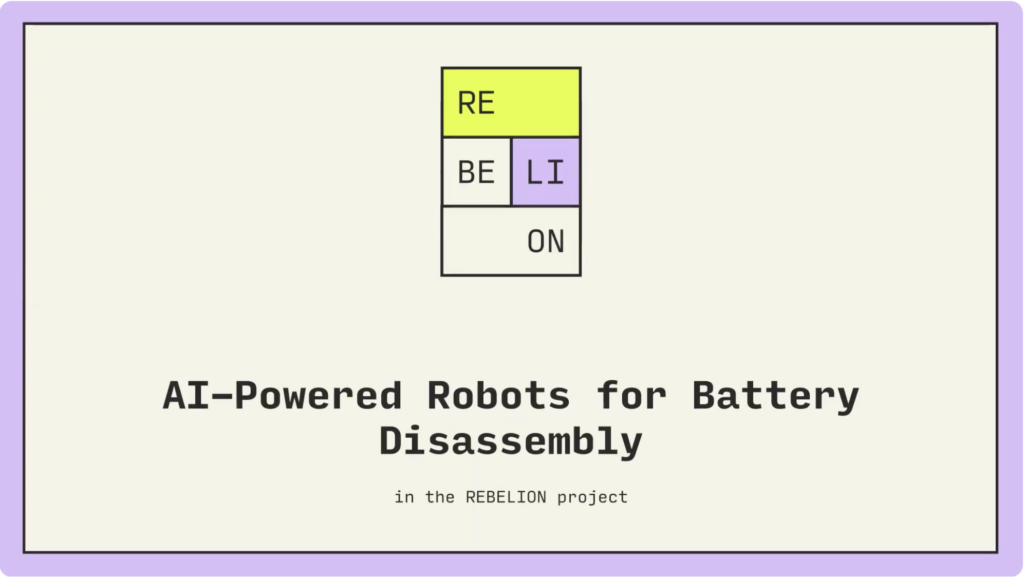
> Click on the image to watch the full interview.
Curious about REBELION’s robotics research? Get in touch or explore the project further on our website.

Featured image by Steve A Johnson on Pexels.

News
May 14, 2026

Automation, AI and scalability in EV battery disassembly

Some significant insights from the Circular Battery Cluster joint activities have now been featured in an article published by Manufacturing Tomorrow, the online trade magazine focused on Industry 4.0, advanced manufacturing and factory automation. The article builds on the exchange between researchers and experts from four Horizon Europe projects working on circular battery ecosystems and […]

Some significant insights from the Circular Battery Cluster joint activities have now been featured in an article published by Manufacturing Tomorrow, the online trade magazine focused on Industry 4.0, advanced manufacturing and factory automation.

The article builds on the exchange between researchers and experts from four Horizon Europe projects working on circular battery ecosystems and automated EV battery disassembly — REBELION, RECIRCULATE, REINFORCE and BATTEREVERSE.

The discussion explores why scaling battery disassembly is no longer simply a question of robotics or AI capabilities. The real challenge lies in the complexity of battery ecosystems: highly variable battery designs, limited standardisation, lack of accessible lifecycle data, and the need for adaptive and flexible disassembly workflows.

Representing REBELION, Professor Rustam Stolkin and Dr Alireza Rastegarpanah shared insights into the project’s work on adaptive robotics, AI-supported perception systems, digital twins and human-in-the-loop approaches for battery disassembly in highly variable environments.

Across the different contributions, three key messages clearly emerged:

  • the main bottleneck today is not automation itself, but battery variability and the absence of standardised disassembly approaches;
  • efficient battery recycling increasingly depends on data availability, including Digital Product Passports and AI-supported decision-making systems;
  • the future of battery disassembly will likely rely on flexible human-robot collaboration and adaptive systems rather than fully rigid automated production lines.

Overall, the discussion highlighted how the transition towards a truly circular battery economy will require stronger integration between robotics, AI, data infrastructures, recycling processes and product design.

Read the full article.

Cover image by Michael Markof on pexels.