

Events
Oct 20, 2026 to Oct 22, 2026
Allianz MiCo
Milan Italy

REBELION at NetZero Milan 2026

The REBELION Consortium is pleased to announce its participation in NetZero Milan 2026, taking place from 20–22 October 2026 at Allianz MiCo, Milan (Italy). As one of Europe’s leading events dedicated to the net-zero transition, NetZero Milan brings together industry leaders, research organisations, public authorities, innovators and investors to accelerate the deployment of sustainable technologies. […]

The REBELION Consortium is pleased to announce its participation in NetZero Milan 2026, taking place from 20–22 October 2026 at Allianz MiCo, Milan (Italy).

As one of Europe’s leading events dedicated to the net-zero transition, NetZero Milan brings together industry leaders, research organisations, public authorities, innovators and investors to accelerate the deployment of sustainable technologies. The event provides an excellent opportunity for REBELION to engage with key stakeholders and showcase its contribution to more circular and sustainable battery value chains.

REBELION, now approaching its final phase, will be featured at the ICONS Stand within the Solutions Hub, alongside other EU-funded projects coordinated and supported by ICONS. Visitors will have the opportunity to discover the project’s objectives, ongoing activities and latest developments, and discuss its innovative approach to battery circularity with consortium representatives.

REBELION is developing innovative solutions to improve the diagnosis, second-life assessment and recycling of end-of-life lithium-ion batteries from electric mobility. By supporting more efficient and circular battery value chains, the project contributes to Europe’s transition towards a sustainable and climate-neutral economy.

See you at NetZero Milan 2026!

Stop by the ICONS Stand to discover REBELION’s work, meet the project team, and explore how collaboration can drive the future of circular battery technologies.

Featured image by Francesco Ungaro on Pexels.

News
Jun 24, 2026

REBELION innovations showcased at Battery Recycling Conference 2026

From safer battery transport to digital traceability, REBELION partner ERION showcased some of the project’s key innovations at the Battery Recycling Conference 2026 in Frankfurt, highlighting solutions that support a more circular, transparent and sustainable battery value chain. Held on 17-18 June, the conference brought together industry leaders, technical experts and policymakers to discuss the […]

From safer battery transport to digital traceability, REBELION partner ERION showcased some of the project’s key innovations at the Battery Recycling Conference 2026 in Frankfurt, highlighting solutions that support a more circular, transparent and sustainable battery value chain.

Held on 17-18 June, the conference brought together industry leaders, technical experts and policymakers to discuss the future of battery recycling, reuse and material recovery in response to the growing demand for electric mobility, energy storage and sustainable manufacturing.

Representing the REBELION consortium, ERION presented several innovations aimed at improving safety and transparency throughout the battery lifecycle.

Among them, particular attention was given to the project’s safe container, designed to enhance the storage and transport of lithium batteries. The solution combines passive and active safety systems capable of detecting and mitigating thermal runaway events, helping to reduce risks for operators, infrastructure and the environment.

ERION also highlighted the role of the Digital Battery Passport, a key enabler for battery circularity. By providing reliable information on battery origin, composition and performance, the Digital Battery Passport will improve traceability throughout the battery lifecycle and support compliance with the evolving European regulatory framework.

By addressing both safety and transparency, REBELION is contributing to the development of a more resilient and circular battery ecosystem, supporting Europe’s transition towards sustainable energy storage solutions.

Featured image by Bruno Glätsch on Pexels.

News
Jun 11, 2026

REBELION General Assembly Marks Final Project Phase

On 9–10 June 2026, the REBELION consortium met in Spain for a two-day General Assembly hosted by project coordinator Universitat Politècnica de València. Taking place between Alcoy and Valencia, the meeting represented an important milestone as the project enters its final months and partners intensify their efforts towards the successful completion of all planned activities. […]

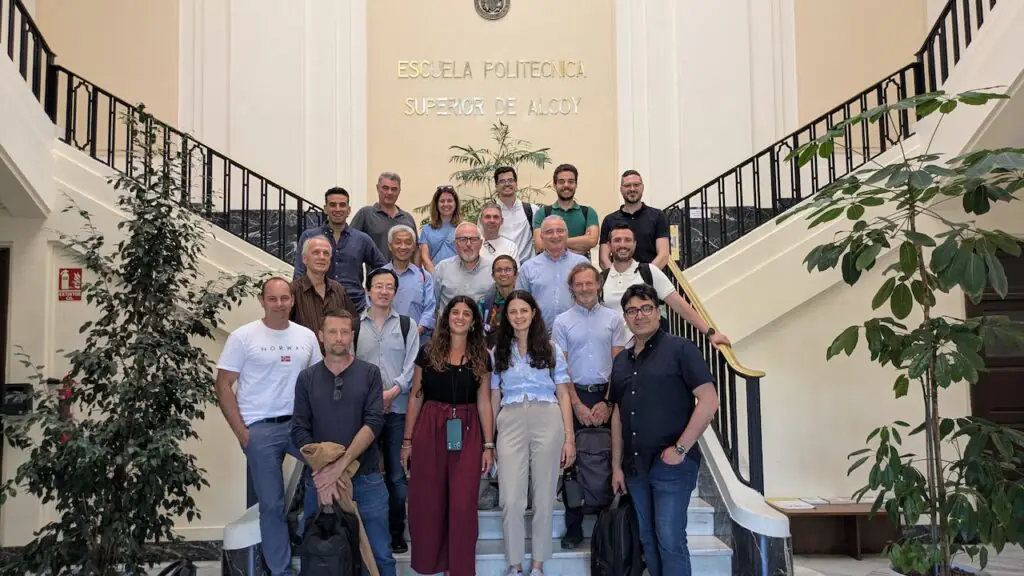
On 9–10 June 2026, the REBELION consortium met in Spain for a two-day General Assembly hosted by project coordinator Universitat Politècnica de València. Taking place between Alcoy and Valencia, the meeting represented an important milestone as the project enters its final months and partners intensify their efforts towards the successful completion of all planned activities.

Day 1 in Alcoy

The first day was held in Alcoy, at the Universitat Politècnica de València’s campus. The morning was dedicated to a comprehensive review of all work packages, allowing partners to assess the progress achieved in recent months, identify areas requiring additional effort before the project’s conclusion, and align priorities for the final implementation phase. These discussions were particularly valuable in clarifying interdependencies among work packages and strengthening collaboration across partners involved in shared tasks.

In the afternoon, participants visited the UPV laboratory facilities and attended a demonstration of the Safety Container developed within the project, providing an opportunity to observe key technical developments firsthand and discuss their integration within the broader REBELION framework.

Day 2 in Valencia

The second day took place at UPV’s main campus in Valencia and focused on planning the next steps towards the project’s final objectives. Special attention was devoted to the System Validation and Use Case Study in the Pilot Plant, one of the project’s most significant activities and a task that requires close cooperation among all consortium partners.

To facilitate productive exchanges, dedicated working groups were organised around specific topics. Their conclusions and recommendations were then presented and discussed with the entire consortium, helping to define a common path forward for the remaining months of the project.

Beyond the technical activities, partners also agreed on a number of strategic actions related to communication, dissemination, and exploitation, ensuring that REBELION’s results will reach relevant stakeholders and maximise their impact beyond the project’s lifetime.

Conclusions and next steps

The General Assembly confirmed the strong commitment of all partners to achieving the project’s goals. The meeting took place in a highly collaborative and constructive atmosphere, combining focused technical discussions with valuable opportunities for networking and team building. As REBELION approaches its final stage, the consortium remains fully engaged in delivering the project’s innovative solutions and ensuring the successful completion of all planned activities.

News
May 14, 2026

Automation, AI and scalability in EV battery disassembly

Some significant insights from the Circular Battery Cluster joint activities have now been featured in an article published by Manufacturing Tomorrow, the online trade magazine focused on Industry 4.0, advanced manufacturing and factory automation. The article builds on the exchange between researchers and experts from four Horizon Europe projects working on circular battery ecosystems and […]

Some significant insights from the Circular Battery Cluster joint activities have now been featured in an article published by Manufacturing Tomorrow, the online trade magazine focused on Industry 4.0, advanced manufacturing and factory automation.

The article builds on the exchange between researchers and experts from four Horizon Europe projects working on circular battery ecosystems and automated EV battery disassembly — REBELION, RECIRCULATE, REINFORCE and BATTEREVERSE.

The discussion explores why scaling battery disassembly is no longer simply a question of robotics or AI capabilities. The real challenge lies in the complexity of battery ecosystems: highly variable battery designs, limited standardisation, lack of accessible lifecycle data, and the need for adaptive and flexible disassembly workflows.

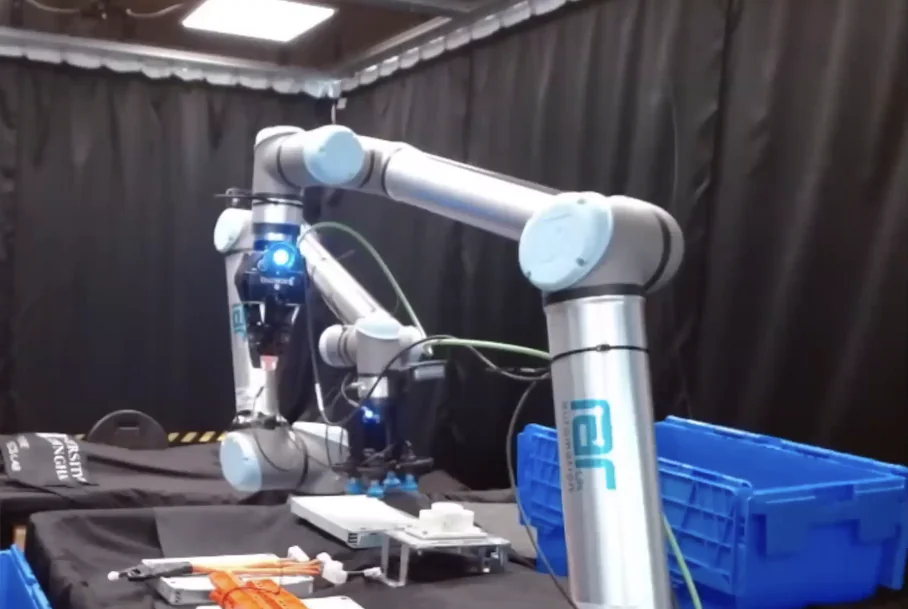
Representing REBELION, Professor Rustam Stolkin and Dr Alireza Rastegarpanah shared insights into the project’s work on adaptive robotics, AI-supported perception systems, digital twins and human-in-the-loop approaches for battery disassembly in highly variable environments.

Across the different contributions, three key messages clearly emerged:

  • the main bottleneck today is not automation itself, but battery variability and the absence of standardised disassembly approaches;
  • efficient battery recycling increasingly depends on data availability, including Digital Product Passports and AI-supported decision-making systems;
  • the future of battery disassembly will likely rely on flexible human-robot collaboration and adaptive systems rather than fully rigid automated production lines.

Overall, the discussion highlighted how the transition towards a truly circular battery economy will require stronger integration between robotics, AI, data infrastructures, recycling processes and product design.

Read the full article.

Cover image by Michael Markof on pexels.

News
Mar 31, 2026

Watch the full REBELION webinar on AI and robotics for battery inspection and recycling

On 18 March, REBELION co-hosted a well-attended webinar with Recirculate as part of the Circular Battery Cluster, focusing on the role of AI and robotics in battery inspection, disassembly, and recycling. The session, titled “Automated vs Manual: How Robotics Are Transforming Battery Inspection”, explored how AI-driven automation and robotics are enabling safer, faster, and more […]

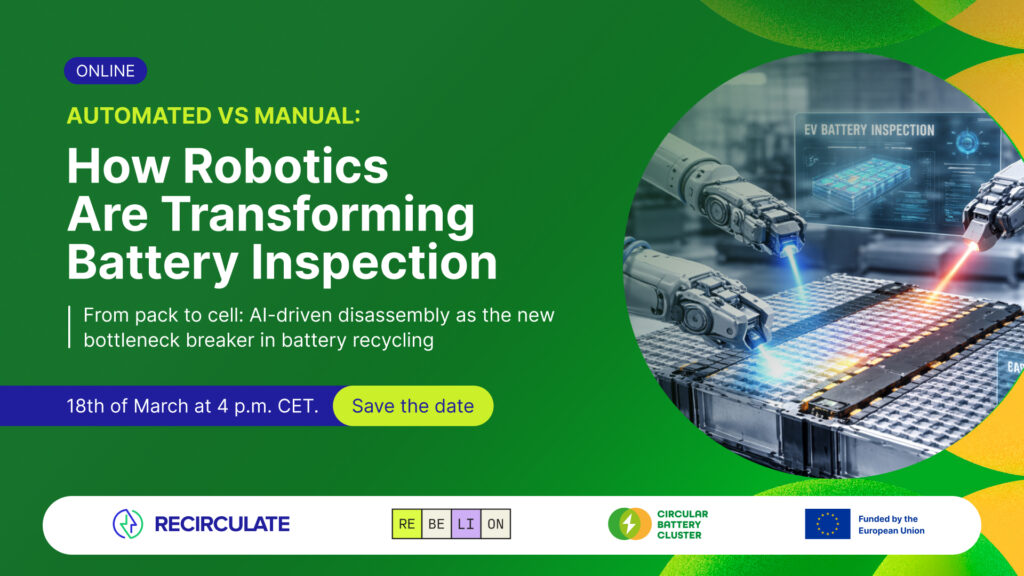
On 18 March, REBELION co-hosted a well-attended webinar with Recirculate as part of the Circular Battery Cluster, focusing on the role of AI and robotics in battery inspection, disassembly, and recycling.

The session, titled “Automated vs Manual: How Robotics Are Transforming Battery Inspection”, explored how AI-driven automation and robotics are enabling safer, faster, and more scalable solutions compared to traditional manual processes. Speakers shared insights on current industry practices, technological advancements, and persistent challenges, including data availability, standardisation, and the diversity of battery designs.

Discussions covered a range of topics, from AI- and robotics-enabled disassembly (from pack to cell level) to machine learning approaches for component identification, as well as automated inspection systems supporting condition assessment and informed decisions on reuse or recycling. The role of automation in improving integration between inspection and disassembly processes was also highlighted as a key enabler for a more efficient and scalable circular battery ecosystem.

> Click on the image to watch the full webinar recording.

This event is part of the Circular Battery Cluster series, promoting collaboration and knowledge exchange across EU-funded projects.

Follow REBELION and the Circular Battery Cluster for more updates on battery recycling, circularity, and innovation.

News
Mar 13, 2026

REBELION contribution to ICONS battery report

The REBELION project contributed to the ICONS report “Catalysing Battery Innovation – Driving Impact Across Europe’s Battery R&D Ecosystem”, released on 11 March 2026. The report provides an overview of Europe’s battery value chain, examining emerging technologies, industrial challenges, and pathways for scaling innovation. REBELION shared insights from its work on second-life applications, recycling, and […]

The REBELION project contributed to the ICONS report “Catalysing Battery Innovation – Driving Impact Across Europe’s Battery R&D Ecosystem”, released on 11 March 2026.

The report provides an overview of Europe’s battery value chain, examining emerging technologies, industrial challenges, and pathways for scaling innovation.

REBELION shared insights from its work on second-life applications, recycling, and refurbishment, helping to illustrate how circular approaches can extend battery lifetimes and support more sustainable management of used batteries.

The project also highlighted the potential of automation, AI, and robotics for battery inspection and disassembly, showing how these technologies can support safer, faster, and more scalable practices in industrial contexts.

By contributing to the report, REBELION aims to support evidence-based decision-making and knowledge exchange across Europe’s battery research and innovation community.

Download and read the full report.

Cover image by Sam Roy on Unsplash.


Events
Mar 18, 2026
Webinar

AI and Robotics Transforming Battery Inspection and Recycling

Battery inspection and disassembly are emerging as key bottlenecks in the circular battery value chain. While manual processes remain slow, costly, and potentially risky, AI‑driven automation and robotics are enabling safer, faster, and more scalable solutions. A dedicated webinar, co-hosted by REBELION and Recirculate within the Circular Battery Cluster, will take place on 18 March at […]

Battery inspection and disassembly are emerging as key bottlenecks in the circular battery value chain. While manual processes remain slow, costly, and potentially risky, AI‑driven automation and robotics are enabling safer, faster, and more scalable solutions.

A dedicated webinar, co-hosted by REBELION and Recirculate within the Circular Battery Cluster, will take place on 18 March at 16:00 CET to examine how AI and robotics are reshaping battery inspection, reuse, and recycling in industrial settings.

The session will compare manual and automated approaches, examining industry practices, technological advancements, and ongoing challenges such as data availability, standardisation, and diverse battery designs. Topics include AI‑ and robotics‑enabled disassembly from pack to cell level, machine learning for component identification, and automated inspection systems that support condition assessment and strategic reuse or recycling — even without QR codes or Digital Product Passports.

The webinar will also address how automated inspection can strengthen decision‑making and improve integration between inspection and disassembly systems, contributing to a more efficient and scalable circular battery ecosystem.

Join the webinar
Automated vs Manual: How Robotics Are Transforming Battery Inspection
18 March – 16:00 CET

Speakers

Tomi Pitkäaho – PhD, Principal Lecturer in Research, Centria University of Applied Sciences
Rustam Stolkin – Professor, Chair of Robotics, University of Birmingham, Founder and Director of the Extreme Robotics Lab
Alireza Rastegarpanah – Visiting Professor, Lecturer, Aston University School of Computer Science and Digital Technologies
Giampiero Pupillo – Automation Engineer, Comau
Óscar Palacín Domínguez – Researcher, R+D+i Project Manager, Eurecat – Technology Centre

This is the second event in the Circular Battery Cluster series, fostering knowledge exchange across research, industry, and innovation.

News
Feb 9, 2026

REBELION moves into its final year after Birmingham Review Meeting

On 3–4 February, the REBELION consortium gathered in Birmingham, UK, for its second Review Meeting, hosted by The Extreme Robotics Lab at the University of Birmingham, a partner of the project. During the two-day meeting, partners reviewed the progress achieved so far and confirmed that REBELION is advancing according to plan. As REBELION enters its […]

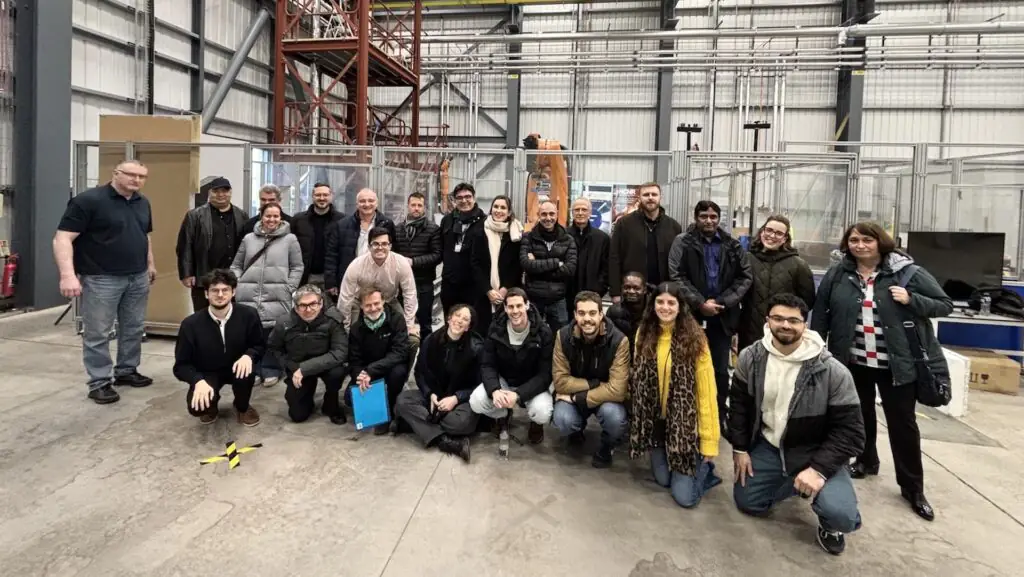
On 3–4 February, the REBELION consortium gathered in Birmingham, UK, for its second Review Meeting, hosted by The Extreme Robotics Lab at the University of Birmingham, a partner of the project.

During the two-day meeting, partners reviewed the progress achieved so far and confirmed that REBELION is advancing according to plan. As REBELION enters its final year, set to conclude at the end of December 2026, discussions focused on consolidating results and preparing for the next steps.

Taking advantage of the visit, consortium members also toured the Sustainable Robotics Centre at the Birmingham Energy Innovation Centre (Tyseley Technology Park), gaining further insight into cutting-edge research infrastructures in the field.

About REBELION

REBELION is an EU-funded project tackling the waste management challenges of lithium-ion batteries used in electric mobility. By developing advanced recycling solutions, the project aims to recover and valorise critical raw materials, strengthening Europe’s strategic autonomy and supporting a more sustainable and competitive battery value chain.


News
Jan 14, 2026

Inside REBELION: CMT on safe container design for lithium-ion batteries

A new video interview is now available on the REBELION YouTube channel, featuring Antonio García Martínez from project partner CMT – Clean Mobility & Thermofluids, a research and postgraduate training center focused on applied thermo-fluid science within the Universitat Politècnica de València (UPV). In his contribution, Antonio García Martínez describes CMT’s role in REBELION, focused […]

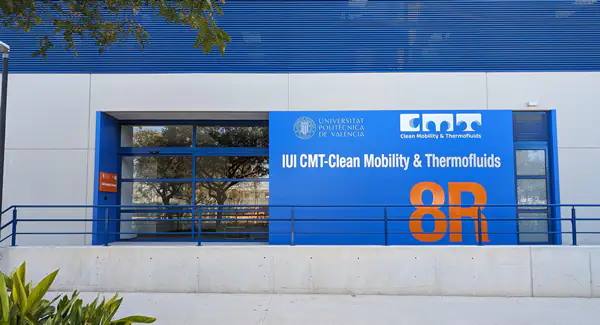
A new video interview is now available on the REBELION YouTube channel, featuring Antonio García Martínez from project partner CMT – Clean Mobility & Thermofluids, a research and postgraduate training center focused on applied thermo-fluid science within the Universitat Politècnica de València (UPV).

In his contribution, Antonio García Martínez describes CMT’s role in REBELION, focused on improving safety in the transport and storage of lithium-ion batteries. The work includes the development and testing of a dedicated container that combines different safety solutions to reduce risks in case of fire.

The video also highlights the main challenges behind this work, such as balancing safety, weight, cost, and storage capacity while integrating components from different sources.

> Click on the image to watch the full interview.

Cover image: courtesy of CMT – Clean Mobility & Thermofluids, Universitat Politècnica de València.

News
Dec 17, 2025

REBELION General Assembly: Progress and Final-Year Priorities

The REBELION consortium convened online for its General Assembly, on 16 December 2025, bringing together all project partners to review progress achieved so far and align on the next steps as the project enters its final phase. During the meeting, each work package leader presented updates on ongoing activities, key achievements, and remaining tasks. The […]

The REBELION consortium convened online for its General Assembly, on 16 December 2025, bringing together all project partners to review progress achieved so far and align on the next steps as the project enters its final phase.

During the meeting, each work package leader presented updates on ongoing activities, key achievements, and remaining tasks. The discussions provided a comprehensive overview of the technical, scientific, and coordination progress across the project, confirming that activities are advancing as planned. At the same time, partners addressed a number of open points that will require focused attention during the final project year.

A session of the General Assembly focused on planning the final phase of REBELION. The last year of the project will place a strong emphasis on exploitation, uptake, and impact generation, with the aim of translating research and innovation results into practical, usable outcomes for stakeholders across the battery value chain. Partners discussed strategies to consolidate Key Exploitable Results, strengthen engagement with industry and policymakers, and maximise the long-term value of REBELION’s contributions to circular battery systems and European battery innovation.

The General Assembly confirmed the consortium’s shared commitment to delivering high-quality results and working collaboratively to address remaining challenges, ensuring that REBELION concludes with a solid foundation for sustained impact beyond the project lifetime.

Cover image by Sigmund on Unsplash.