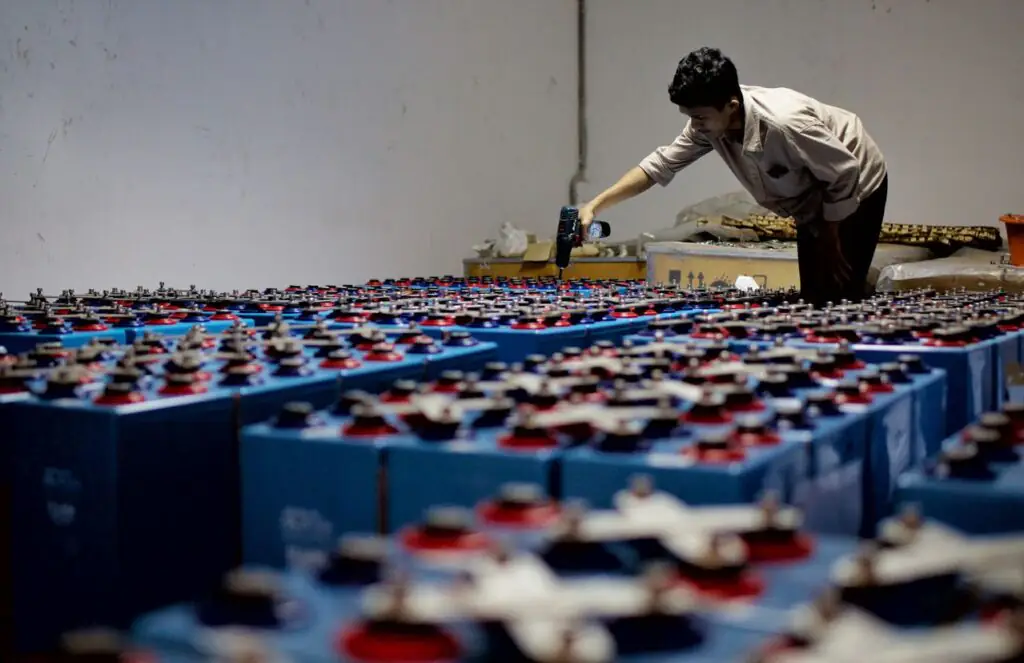


Research from the University of Birmingham highlights AI and robotic disassembly as key solutions for sustainable lithium-ion battery recycling, supporting REBELION’s mission.
The University of Birmingham, associated partner in the REBELION project, has recently contributed to many research in the field of robotic disassembly, which has the potential to revolutionize the way we approach end-of-life products and waste management. As the global demand for electric vehicles (EVs) increases, the need for efficient recycling and disassembly of lithium-ion batteries (LIBs) has become more critical.
The first of their recent studies, titled Robotic disassembly for end-of-life products focusing on task and motion planning, highlights the role of Task and Motion Planning (TAMP) in improving the efficiency, adaptability, and safety of robotic disassembly processes. By integrating AI-driven technologies such as reinforcement learning (RL) and vision systems, the research aims to optimize disassembly procedures for complex products like EV batteries.
In another significant paper, Imitation learning for sim-to-real adaptation of robotic cutting policies, the team has developed a new method to enhance the transfer of robotic cutting policies from simulations to real-world environments. This technique, which uses imitation learning in combination with Gaussian process regression, allows robots to adapt to varying material properties and disturbances, improving the accuracy and efficiency of cutting tasks in disassembly operations.
These studies not only highlight the transformative potential of robotics in disassembly but also align with REBELION’s mission to advance sustainability and resource efficiency. By incorporating AI, robotics, and innovative technologies into waste management practices, these research efforts contribute to a more circular economy, helping to mitigate the environmental impact of EoL products and promote the responsible recycling of valuable materials.
For more information on these studies and their implications for the future of robotics and sustainability, visit Alireza Rastegarpanah page on Google Scholar.